

After 13 years in Data Science and Analytics, I’ve realized that we spend far more time discussing “innovation” than we do managing the “interest” on our technical debt. We’ve all read the foundational literature from Martin Fowler’s “Technical Debt Quadrant” to Google’s seminal paper, “Hidden Technical Debt in Machine Learning Systems.” These works taught us that debt isn’t just “bad code”; it’s a strategic choice that eventually comes due.
However, as a Lead or Senior Scientist, you don’t always have time to re-read academic papers. You need a way to look at your department today and know where the rot is. I have synthesized these practical leadership heuristics into a 10-minute diagnostic tool designed specifically for data leadership.
This isn’t just about code; it’s about the four systemic pillars that determine whether your team can scale or if you’re one resignation away from a total system collapse.
The Audit: A Practical Synthesis
Note: This framework adapts Fowler’s quadrants and Google’s ML debt categories into four “Data Strategy” buckets.
1. Infrastructure Debt (The Operational Lens)
The Concept: Influenced by Google’s Site Reliability Engineering principles.
The Question: How much manual “toil” is required to maintain your environments? Do you struggle with environment drift (staging vs. prod), unpredictable cloud costs, or gaps in system observability?
1 (Red): High manual overhead; environment configurations are inconsistent; costs are opaque.
2 (Yellow): Basic automation is in place, but system performance and costs require frequent manual troubleshooting.
3 (Green): Infrastructure is version-controlled; costs are optimized via automation; full observability into pipeline health is the baseline.
2. Data Debt (The Governance Lens)
The Concept: Derived from Zhamak Dehghani’s Data Mesh and the Data Contract movement.
The Question: How many “shadow dashboards” exist because users don’t trust the primary data products? Is there a clear framework for data quality, or do inconsistencies lead to constant cross-team debates?
1 (Red): Frequent debates over “whose numbers are right”; no shared definitions for key metrics across domains.
2 (Yellow): Domain-specific data assets exist, but lack a unified governance layer to ensure consistency.
3 (Green): Clear data contracts in place; federated governance ensures consistent metrics across the organization regardless of which team owns the data.
3. Model Debt (The ML Lifecycle Lens)
The Concept: Directly applying the Google “Hidden Technical Debt” research.
The Question: What percentage of production models lack automated drift detection or a scheduled retraining trigger?
1 (Red): “Zombie models” exist; monitoring is reactive (we wait for the user to complain).
2 (Yellow): Standard monitoring is in place, but retraining is manual and ad-hoc.
3 (Green): Robust MLOps; automated circuit-breakers for model performance.
4. Knowledge Debt (The “Bus Factor” Lens)
The Concept: A standard software engineering metric for team resilience.
The Question: If your top two contributors left tomorrow, could the remaining team maintain the systems without a “black box” failure?
1 (Red): Critical systems are undocumented; knowledge is siloed in 1-2 heads.
2 (Yellow): Documentation exists but is 6+ months out of date.
3 (Green): Culture of documentation and cross-training; low “bus factor.”
The Debt-Action Matrix: Your Strategic Playbook
Based on your scores above, here is how I recommend prioritizing your next quarter:
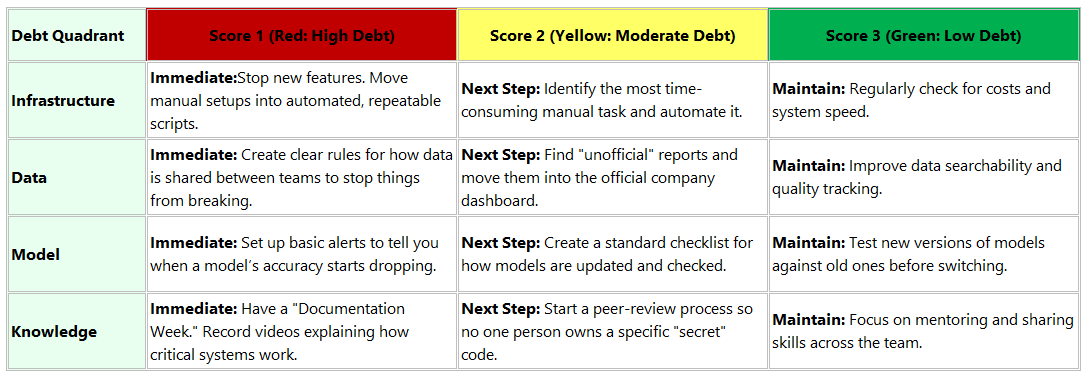
Why Curation is Leadership
The goal of this audit isn’t to achieve a perfect 12/12. As Martin Fowler famously noted, “Deliberate Debt” can be a tool for speed. The danger is “Inadvertent Debt”, the mess that happens when you aren’t looking . By running this audit, you’re moving from accidentally messy to strategically managed. What’s the “highest interest” debt your team is paying right now? Let’s discuss in the comments.
Further Reading & Industry Influences
If you want to dive deeper into the theories that shaped this audit, I highly recommend these foundational resources:
The Technical Debt Quadrant (Martin Fowler): The original 2009 framework that categorized debt into Deliberate vs. Inadvertent and Prudent vs. Reckless.
Hidden Technical Debt in Machine Learning Systems (Google Research): The “must-read” paper for any data leader. It explains why ML systems have a unique way of “eroding boundaries” and creating high-interest debt
The 4 Core Principles of Data Mesh (Zhamak Dehghani): The origin of the “Data as a Product” mindset, which is the best defense against “Data Debt.”
Eliminating Toil (Google SRE Book): The definitive guide to identifying “Infrastructure Debt” and why manual, repetitive tasks (Toil) are the enemy of scaling.
Strong framing. What landed for me was calling out inadvertent debt - most teams don’t choose it, they just wake up inside it.
I also like separating model debt from knowledge debt. I’ve seen orgs invest heavily in MLOps and still be fragile because two people “just know how it works.” That risk rarely shows up in roadmaps until it’s too late.
Curious which pillar you see most often underestimated at leadership level - infra, data, or knowledge?
This piece really made me think. That line about managing the *interest* on tech debt more than 'innovation' is just so true, tho.